

Published on Wednesday 21st July 2021
A Part M ramp is an inclined approach or walkway built specifically to satisfy Requirement M1 of the UK Building Regulations 2010, enabling wheelchair users, parents with buggies, and individuals with limited physical mobility to access and use a building independently and safely.
A Part M ramp is an inclined approach or walkway built specifically to satisfy Requirement M1 of the UK Building Regulations 2010, enabling wheelchair users, parents with buggies, and individuals with limited physical mobility to access and use a building independently and safely.
If you are managing a construction project, upgrading a commercial entrance, or overseeing school estates, navigating UK accessibility laws can feel complex, but installing a Part M compliant ramp ensures your entrance meets statutory building control standards.
This legal requirement originates from Schedule 1 to the Building Regulations 2010. The official statutory guidance published by HM Government to help developers, architects, and specifiers achieve compliance is divided into two distinct volumes:
- Approved Document M: Volume 1 – Dwellings: Focuses on new residential homes across three tiers: Category 1 (Visitable dwellings), Category 2 (Accessible and adaptable dwellings), and Category 3 (Wheelchair user dwellings).
- Approved Document M: Volume 2 – Buildings Other Than Dwellings: Applies to non-domestic spaces, including commercial offices, retail outlets, schools, healthcare facilities, and public venues.
Where site constraints necessitate an approach gradient of 1:20 or steeper from the site boundary or designated parking bay to the building entrance, an approach incorporating a ramped access route must be provided.
We can advise you on the most suitable ramp solution for your specific requirements and supply fully compliant components designed to meet the requirements of Parts M and K of the Building Regulations.
Part M vs. Part K: How the Wider Regulations Work Together
When specifying or installing an access ramp in the UK, you cannot look at Approved Document M in isolation. Ramp design sits at the direct intersection of two key parts of the Building Regulations 2010: Part M (Access to and use of buildings) and Part K (Protection from falling, collision and impact).
How Part M and Part K Work Together?
- Part M Focuses on Accessibility: Its primary objective is ensuring that everyone—regardless of age or disability —can approach and enter a building independently. It dictates ramp gradients, clear widths, level rest landings, visual contrast, and handrails that are comfortable and "warm to the touch" in cold weather.
- Part K Focuses on Safety & Fall Prevention: Its primary objective is safeguarding all pedestrians against physical hazards, falls, or collisions. It sets structural rules for ramp construction, edge protection, guarding heights (900mm along ramp flights and 1100mm on landings), and child-safety containment.
Which Regulation Takes Precedence?
Because both documents address ramps, handrails, and changes in level, building control regulations establish a clear hierarchy: where an access route or entrance ramp is concerned, guidance in Approved Document M explicitly takes precedence over Approved Document K if any conflict arises.
However, the two documents operate co-dependently. For instance, Part M specifies that open sides of ramps require a 100mm raised visual kerb to prevent wheelchair castors or crutches from slipping off, in addition to the structural guarding required under Part K.
Utilising a prefabricated
<a 16px="" a="" access="" admin="" auto="" center="" ckeditor="" class="text-green" hidpi="" data-cke-saved-href="https://www.rapidramp.co.uk/modular-ramps/fully-compliant-modular-ramp" href="https://www.rapidramp.co.uk/modular-ramps/fully-compliant-modular-ramp" https:="" images="" left="" link="" data-cke-saved-name="fully compliant ramp system" name="fully compliant ramp system" no-repeat="" plugins="" ramped="" span="" specifying="" style="background: url(" t="E6FD" )"="" target="_parent" title="fully compliant ramp system" type="Link" www.rapidramp.co.uk="">Usage is an important consideration when specifying. For example, consider the types of traffic using the ramp or steps and the sort of building or space.
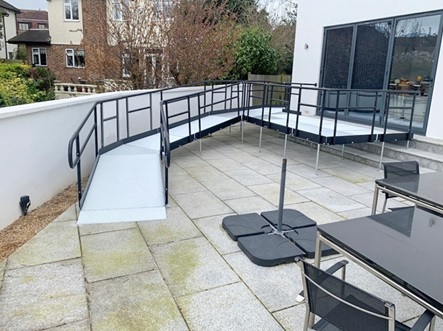
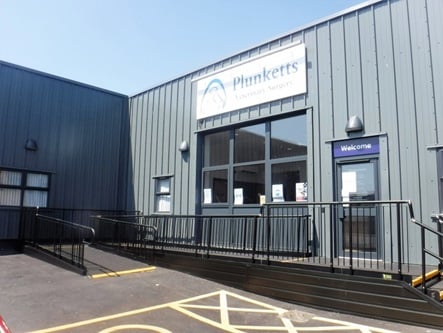
Please note: countless other scenarios are not listed below.
| Example Scenario | Recommended Solution | Case Studies |
|
Private Dwellings Very little daily footfall.
Example Buildings & Spaces - flat, apartment, caravan, mobile home, private house, or garden. |
Our standard ramp. It is the homeowner’s choice if they require a Part m and Part K compliant ramp. A wide platform is recommended if the system is for a powerchair user to provide turning space. |
https://www.rapidramp.co.uk/case-studies/gate-ramp-bexhill
https://www.rapidramp.co.uk/case-studies/caravan-wheelchair-ramp-canterbury |
|
Council-owned properties Very little daily footfall.
Example Buildings & Spaces - garden, house or flat. |
Council properties will need to comply fully with Document M, Volume 1, Dwellings.
A modular ramp is ideal as it can easily be dismantled if the tenant were to move. Also, the ramp can be reused, reconfigured, and relocated at a different council property.
A wide platform is recommended if the tenant is a powerchair user to provide turning space. |
https://www.rapidramp.co.uk/case-studies/hainault-homeless-centre |
|
Festivals & Events High daily footfall is expected with diverse traffic, including prams, pedestrians (adults & children), wheelchair users, mobility scooter users, and heavy-duty trollies.
Example Buildings & Spaces - accessible toilets, changing facilities, marquees,viewing platforms, warfare cabins and temporary walkways. |
A temporary, fully compliant ramp on hire. Concrete pads can be added underneath the feet to ensure rigidity in muddy conditions. |
https://www.rapidramp.co.uk/case-studies/university-graduation-ceremony
www.rapidramp.co.uk/case-studies/mobile-changing-unit-preston |
|
Airports & Train Stations High daily footfall is expected with diverse traffic, including prams, bikes, pedestrians (adults & children), wheelchair users, mobility scooters users and luggage trollies. |
A fully compliant ramp with wide GRP, slip-resistant platforms.
Wide platforms provide turning space for wheelchairs and trollies. Plus, they can be designed to cover traffic moving in both directions. Our platforms have a weight capability of 1,000kgs. |
https://www.rapidramp.co.uk/case-studies/wigan-wallgate-train-station
https://www.rapidramp.co.uk/case-studies/semi-permanent-wheelchair-ramps-manchester-airport |
|
Schools High daily footfall, mainly students and staff.
Example Buildings & Spaces - playgrounds, modular classrooms, offices and other school buildings. |
A slip-resistant, fully compliant ramp with Safetread Rubber Crumb Surface and Fine Underside Mesh.
Safetread Rubber Crumb is a soft, slip-resistant ramp covering that reduces the impact of falls. The product is made from the same materials used in soft play areas. Fine Underside Mesh has 20mm x 20mm small square holes designed to stop litter from blowing underneath the ramp. |
https://www.rapidramp.co.uk/case-studies/palmarsh-primary-school
https://www.rapidramp.co.uk/case-studies/woodthorpe-infant-school
|
|
Vets Large daily footfall is expected with diverse traffic, including prams, pedestrians (adults & children), wheelchair users, and dogs. |
A fully compliant ramp with Safetread Rubber Crumb Surface and Underside Mesh Hoarding.
Safetread Rubber Crumb is a slip-resistant, soft padded surface ideal for a dog’s paws and craws.
Underside Mesh Hoarding is designed to prevent children and animals from gaining access to the underneath of the ramp. It is often specified for schools and public buildings. |
https://www.rapidramp.co.uk/case-studies/ramp-for-dogs-plunketts-veterinary-surgery |
|
Hospitals Large daily footfall is expected with diverse traffic, including prams, pedestrians (adults & children), wheelchair users, mobility scooter users, heavy medical equipment, and hospital beds. |
A fully compliant wide ramp with slip-resistant GRP surface.
Wide platforms provide turning space for hospital beds, wheelchairs, and wheeled medical equipment. Plus, they can be designed to cover traffic moving in both directions. Our platforms have a weight capability of 1,000kgs. |
https://www.rapidramp.co.uk/case-studies/hammersmith-hospital
https://www.rapidramp.co.uk/case-studies/modular-platforms-qeqm-hospital
https://www.rapidramp.co.uk/case-studies/sedlescombe-house-surgery |
Part M & K design points for dwelling ramps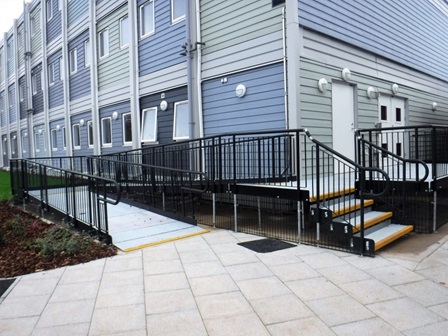
- The minimum width of a ramped approach is 900mm (Doc M, Vol 1. P12, 2.9B).
- If the ramp height exceeds 600mm, then Infill handrail is required to prevent falling (Doc K, Page 22.A).
- Once the maximum length of the ramp has been achieved, you should provide a level landing to allow the user to rest. The minimal length of a level platform is 1200mm (Doc M, Vol 1, P13, 2.10g).
- The maximum gradient that your ramp can reach is determined by the change in rise (aka the height) to overcome. If the maximum gradient has been reached, a resting platform must be provided to allow the user to pause, as they may become tired and out of breath.
- Often a dwelling ramp can accomplish a gradient of 1:12.
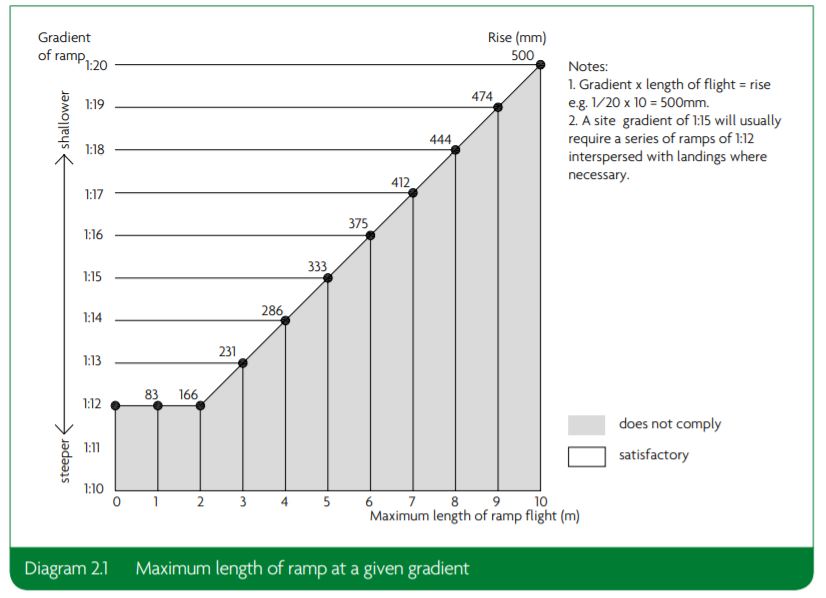
Diagram – The relationship of ramp gradient to the going of a flight.
Part M & K design points for public and other buildings 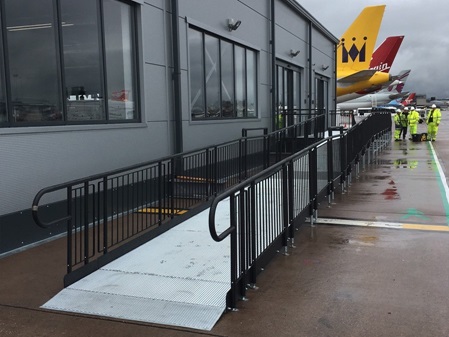
- The minimum width of a ramped approach is 1500mm (Doc M, Vol 2, P19, 1.26e).
- Once the maximum length of the ramp has been achieved, you should provide a level landing to allow the user to rest. The minimal length of a level platform is 1500mm (Doc M, Vol 2, P20 / Doc K, 2.13b).
- The maximum length of a ramp can be found in the above diagram.
- You can specify continuous handrails (Doc K, P14, 1.35).
- The minimum step width is 1500mm (Doc M, Vol 2, P19, 1.26e)
- The minimum handrail height for a level platform is 1100mm (Doc M, P24, Diagram 3.1)
- If the ramp height exceeds 380mm, then Infill handrail is required to prevent falling (Doc K, P16, 1.39a/22b).
- The maximum gradient that your ramp can reach is determined by the change in rise (aka the height) to overcome. If the maximum gradient has been reached, a resting platform must be provided to allow the user to pause, as they may become tired and out of breath.
- Often ramps for public use (whether to a building or space) can accomplish a minimum ramp gradient of 1:15 or a 1:20 gradient is frequently specified.
.jpg)
.jpg)
Free Quick Quote
Request a quick quote or email [email protected] with the full project address, drawings, photos and contact details.
THE UK’S EXPERTS IN MODULAR RAMP SYSTEMS.
Rapid Ramp
Riverside Works, Church Ln, Etchingham, TN19 7AS
Hours:
8am - 5pm, Monday to Friday
Products
Services
Projects
Sector
Resources
Calculators


