


Published on Monday 5th July 2021
For wheelchair accessible doors in the UK, the key measurement is the clear opening width, not just the door leaf size. As a general guide, accessible doorways should provide enough clear space for wheelchair users to pass through safely, with requirements varying by building type, approach angle and whether the doorway is internal or external.
For wheelchair accessible doors in the UK, the key measurement is the clear opening width, not just the door leaf size. As a general guide, accessible doorways should provide enough clear space for wheelchair users to pass through safely, with requirements varying by building type, approach angle and whether the doorway is internal or external.
Why Is The Wheelchair Door Width Is Important?
Achieving the correct wheelchair-accessible door width is an important part of ensuring safe, compliant and inclusive access. For architects and site managers, following the relevant requirements helps reduce project risk and ensures that doorways can be used independently by wheelchair users and people with mobility needs.
UK door-width requirements are primarily covered by Approved Document M, with Approved Document K also relevant to safety and access. The requirements can vary depending on whether the building is a private dwelling or a public or commercial building, so the correct standards should be considered at the design stage.
Getting the door width right can also help prevent costly alterations later in the project. It is important to consider the clear opening width, rather than simply the overall size of the door, to ensure there is sufficient space for a wheelchair and other mobility aids to pass through safely and comfortably.
In some situations, the door threshold may create an additional barrier for wheelchair users. Where a threshold cannot be avoided, a suitable door access ramp can be installed to overcome the change in level and provide easier wheelchair access through the doorway. This can create a smoother transition into the building and help maintain a safe and accessible route for all users.


Residential Door Standards For Wheelchair Accessibility (Document M, Volume 1)
For private homes, the door width is often increased beyond standard sizes to ensure residents using mobility aids and wheelchairs can navigate their homes and gardens with dignity. These requirements are categorised into "Visitable," "Accessible and Adaptable," and "Wheelchair User" dwellings.
Table 1: Residential Door Width Requirements.
| Door Type | Minimum Clear Opening | Recommended Opening | Notes |
| Principal Private Entrance | 775mm | 900mm |
The legal minimum is 775mm. 900mm is recommended for modern, larger wheelchairs. Reference: Approved Document M: Volume 1 - Dwellings, Section 1B, 1.15. |
| Internal Habitable Rooms | 750mm | 850mm |
Applies to all rooms on the entrance storey, including WCs and kitchens. Internal doorways can be widened to facilitate movement between rooms, supporting individuals with disabilities. Reference: Approved Document M: Volume 1 - Dwellings, Section 1B, 1.16. |
| Communal Entrances | 775mm | 1000mm+ |
Must accommodate higher traffic volumes. Reference: Approved Document M: Volume 1 - Dwellings, Section 1A, 1.9
|
| External Garden Doors | 775mm | 900mm |
Should provide an accessible threshold for garden access. Reference: Approved Document M: Volume 1 - Dwellings, Section 2B, 2.20 |
Public Building Door Width Standards (Document M, Volume 2)
An accessible door width for public facilities must accommodate high traffic, including pedestrians, wheelchair users, and parents with double buggies. Under Document M, Volume 2, "accessible doors" must be wide enough to allow unrestricted passage for those with assistance dogs or heavy luggage.
Table 2: Public Buildings & Commercial Settings
| Door Type | Minimum Clear Opening | Recommended Opening | Notes |
| Main Public Entrance | 800mm - 100mm | 1000mm+ |
1000mm is required for external doors used by the general public in new buildings. Reference: Approved Document M: Volume 2 - Buildings other than dwellings, Table 2. |
| Internal Accessible Doors | 750mm - 800mm | 900mm |
Width varies based on the direction of approach. Reference: Approved Document M: Volume 2 - Buildings other than dwellings, Table 2. |
| Communal Residential | 775mm | 1200mm |
Minimum clear width for communal usage in residential blocks.
Reference: Approved Document M: Volume 2 - Buildings other than dwellings, Section 3.14.
|
| Public Access Ramps | 1500mm+ | 1500mm+ |
The minimum width for modular ramps in non-dwellings. Reference: Approved Document M: Volume 2 - Buildings other than dwellings, Section 2.9. |
The Impact Of Approach Angles And Turning Space
A common oversight when calculating the doorway width for a wheelchair is the angle of approach. If a user cannot approach the door "head-on," the wheelchair door width must increase to allow for a wider turning arc.
Table 3: Minimum Corridor Widths vs. Door Widths
|
Required Clear Opening
|
Technical Reference & Notes | |
| 1200mm or wider | 750mm |
Standard width is sufficient with ample turning space.
Reference: Approved Document M: Volume 1, Table 1.1 / Volume 2, Table 2.
|
| 1050mm to 1200mm | 775mm |
Required to compensate for the tighter turning arc. Reference: Approved Document M: Volume 1, Table 1.1 / Volume 2, Table 2. |
| 900mm to 1050mm | 800mm |
Narrower hallways require the widest standard door opening.
Reference: Approved Document M: Volume 1, Table 1.1 / Volume 2, Table 2.
|
| Below 900mm | Not Recommended |
Corridors should ideally be 900mm-1200mm wide for safe wheelchair access. Reference: Approved Document M: Volume 2, Section 3.14
|
Where a ramp is required to provide wheelchair access over a high door threshold, please use our ramp calculator to ensure a compliant gradient is achieved.
Common Accessibility Mistakes to Avoid
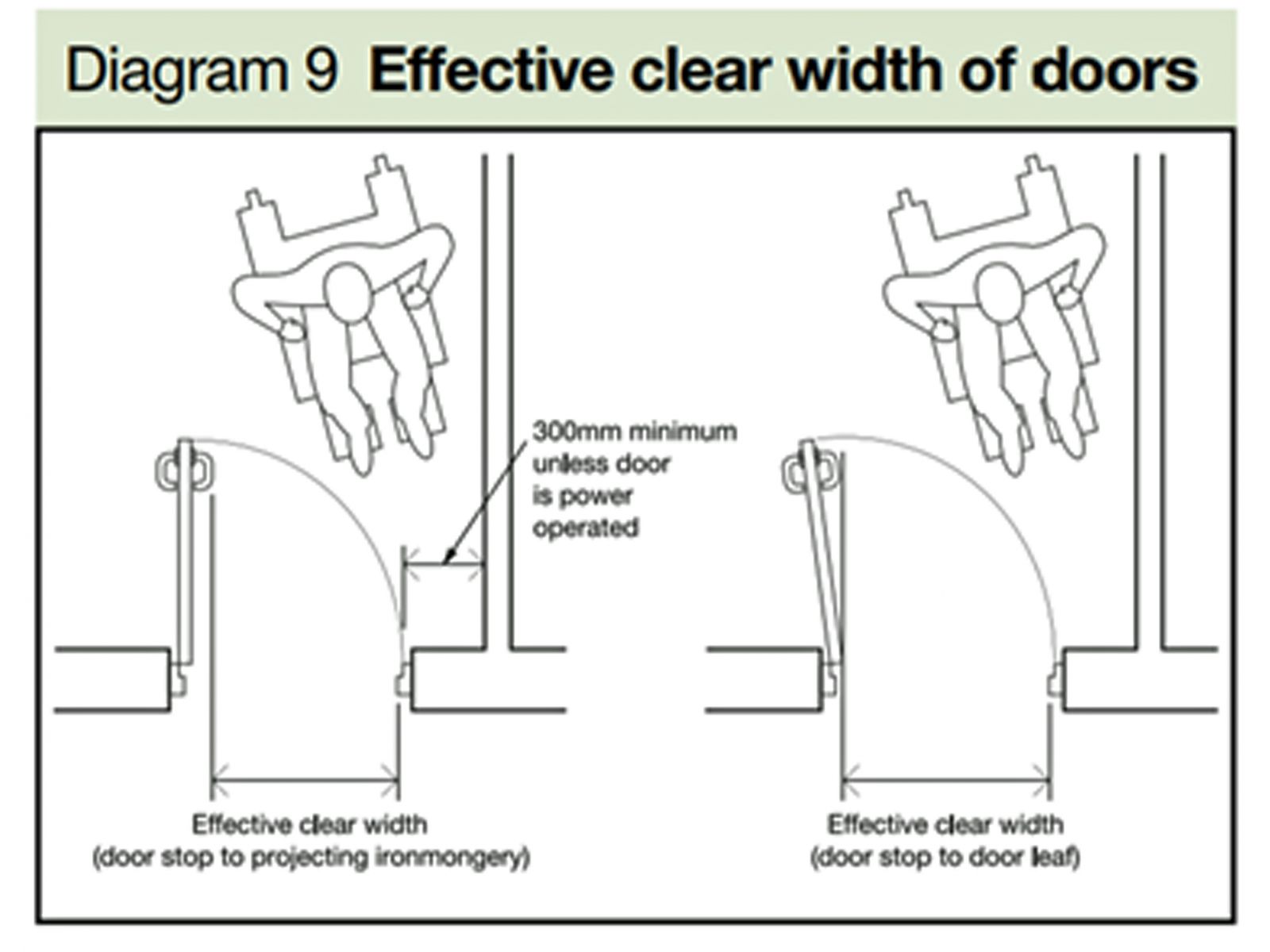
- Measuring the Door Leaf vs. Clear Opening: The width of a handicap door is the usable space when open at 90 degrees, measured from the face of the door to the doorstop. A standard 826mm door leaf usually satisfies a 775mm clear opening requirement.
- Ignoring Approach Angles: As shown in Table 3, narrow corridors require significantly wider doors to remain compliant.
- Forgetting Threshold Height: A wide door is a barrier if the threshold is too high. An accessible threshold should have a maximum upstand of 15mm with a tapered profile.
- Neglecting Turning Space: Regulation requires a 1500mm clear turning circle to be available immediately inside or outside the entrance to allow for independent manoeuvring.
- Lack of Door Nibs: A 300mm nib (unobstructed space) should be provided on the leading edge of the door to allow a wheelchair user to operate the handle independently.
Threshold Height & Modular Ramp Solutions
Where a step into a building is unavoidable, the rise should not exceed 150mm. To satisfy Building Regulations, any such step should be used in conjunction with a modular ramp to provide a compliant, step-free transition.
If you need a modular ramp to provide compliant, step-free access to these doors, we can help. Our systems are tailored to match the specific widths of various doorways, ensuring every threshold is navigable.
Estimates can be returned within 24hrs if there is clear information given, including project address, drawings, photos and contact details.
FAQs
Q: What is the absolute minimum disabled door width in the UK?
A: For a private dwelling entrance, the minimum clear opening width is 775mm For public buildings, this increases to 1000mm for external doors used by the general public in new constructions
Q: How do I measure the clear opening width for a wheelchair?
A: Measure the distance between the inside face of the door (when open at 90 degrees) and the doorstop on the frame Do not measure the door leaf itself, as its thickness and hinges reduce the usable gap.
Q: Are revolving doors compliant for wheelchair access?
A: No. Revolving doors are not considered accessible They must be accompanied by a standard accessible door immediately adjacent to them.
Q: How wide should a doorway be for a mobility scooter?
A: While wheelchair requirements start at 775mm, wider equipment like mobility scooters or double buggies often require larger openings of 1000mm or more to ensure easy passage.
Q: Can a ramp help if my doorway is wide enough but has a step or high threshold?
A: Yes. If your doorway has an unavoidable step or raised threshold (up to a maximum rise of 150mm), a modular ramp is the ideal solution to achieve a compliant, step-free entrance. These systems are tailored to match the specific width of your doorway, providing a smooth and safe transition over obstacles that would otherwise restrict access for wheelchair users.
Estimates can be returned within 24hrs if there is clear information given, including project address, drawings, photos and contact details.
Useful Links
Reference: Approved Document M (Volume 1 & 2) and Approved Document K.
Please consult the below PDF for the full list of requirements under Documents M, Volume 1 Dwelling - access to and use of buildings.
Minimum Effective Clear Widths Of Doors
Please refer below for the minimum effective clear widths required for both single and double doors:
Click images to enlarge.
.jpg)
Please consult the below PDF for the full list of requirements under Documents M, Volume 2 – Buildings Other Than Dwellings.
CASE STUDIES


THE UK’S EXPERTS IN MODULAR RAMP SYSTEMS.
Rapid Ramp
Riverside Works, Church Ln, Etchingham, TN19 7AS
Hours:
8am - 5pm, Monday to Friday
Products
Services
Projects
Sector
Resources
Calculators


