
Published on Monday 9th November 2026
Yes, wooden wheelchair ramps must legally comply with Approved Documents M and K if they serve public or commercial buildings, council housing, or are funded through local authority adaptation grants. If you are an owner-occupier installing a ramp on a home you own using your own funds, meeting these accessibility standards is generally down to your own discretion.
Yes, wooden wheelchair ramps must legally comply with Approved Documents M and K if they serve public or commercial buildings, council housing, or are funded through local authority adaptation grants. If you are an owner-occupier installing a ramp on a home you own using your own funds, meeting these accessibility standards is generally down to your own discretion.
People often assume that wooden ramps are simply garden structures and therefore exempt from building regulations. However, under the Building Regulations 2010 (England and Wales), an wheelchair ramp is assessed according to the building it provides access to (whether public or private), who will be using the entrance, the property's ownership status, and how the work is funded—not the material used in its construction, whether timber, concrete or steel.
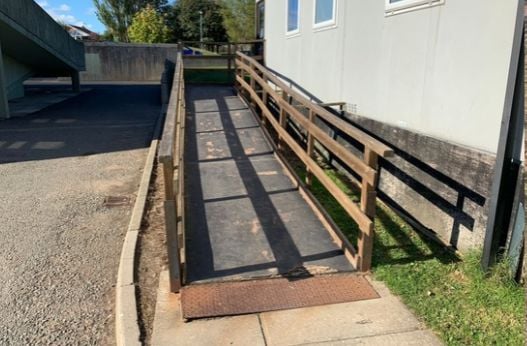
Ramp Regulations by Property Type
| Property & Ownership Type | Do Part M & Part K Apply? | Legal Status |
| Public & Commercial Buildings (Schools, shops, offices, health centres) | Mandatory | Required by Building Regulations and the Equality Act 2010. Must be inspected and signed off by Building Control. |
| Council & Housing Association Properties | Mandatory | Required to satisfy local authority housing accessibility specifications. |
| Grant-Funded Adaptations (e.g. Disabled Facilities Grants) | Mandatory | Required to meet occupational therapy design criteria before grant funds are released. |
| Private Rented Properties (Tenants) | Subject to Landlord & Equality Act Rules | Requires formal landlord consent; installations must meet agreed safety and building standards. |
| Homeowner-Owned Properties (Self-funded owner-occupiers) | Discretionary | Homeowner’s choice, tailored to user needs and garden layout (subject to basic duty of care). |
When Is Compliance Mandatory?
For any building outside the private domestic sector, the law is clear:
- Commercial and Public Premises: Any ramp providing visitor or staff access must achieve compliant gradients (between 1:12 and 1:20 depending on flight length), a minimum clear width of 1500mm, 1200mm level rest landings clear of door swings, continuous warm-to-touch handrails on both sides, and 100mm raised edge kerbs. In addition, under Approved Document M (Section 1.26n) and Approved Document K (Section 2.6a), if a ramp overcomes a vertical rise of 300mm or more, an adjacent flight of compliant steps must also be provided alongside it.
- Council Properties and Grant-Funded Work: Surveying officers inspect installations against statutory accessibility standards. Funding will not be released for non-compliant slopes, inadequate widths, or missing safety handrails.
When Is Compliance at the Homeowner's Discretion?
- Owner-Occupiers (Homes You Own): If you own your home outright and are funding the ramp privately, full compliance with Part M is discretionary. Most private gardens and driveways simply do not have the space for a 1:15 or 1:20 slope with 1200mm rest landings (a 500mm doorstep rise at 1:20 requires a 10-metre ramp flight plus landings). Homeowners have the freedom to design a ramp that fits their specific mobility equipment and available plot.
- Private Rented Dwellings: If you rent privately, you cannot build a ramp without your landlord's formal written consent. Landlords and insurers typically require any structural alterations to comply with standard building practices and safety codes.
- Duty of Care: Even on privately owned homes where Part M dimensions are discretionary, Approved Document K (safety from falling) still matters in principle. Property owners owe a basic duty of care to ensure an outdoor ramp does not create a hazardous falling or slipping risk for visitors, healthcare carers, or postal workers.
Can Wooden Wheelchair Ramps Meet Part M and Part K in Practice?
While a timber ramp can technically be built to satisfy statutory dimensions on day one, keeping outdoor wood compliant over time is genuinely difficult:
- Gradient distortion: As timber boards absorb moisture and seasonal weather causes warping or cupping, an initially compliant 1:15 gradient can shift and become non-compliant.
- Slip resistance: Outdoor timber naturally cultivates algae and moss in damp UK weather, which breaches standard British slip-resistance criteria (BS 8300-1 Annex F) unless heavily treated or coated.
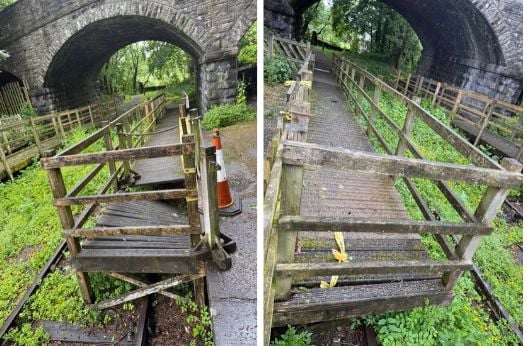
- Combustibility: Timber is combustible, which can cause compliance issues along designated fire escape routes under Approved Document B.
For projects where long-term Building Control approval is required, prefabricated modular steel wheelchair ramps are often specified instead because they are factory-engineered to guaranteed Part M and Part K dimensions, feature permanent slip-resistant surfaces, and often installed on-site in a single day.

Need Help Meeting Ramp Regulations?
If your project must satisfy Part M or Part K and you need a compliant solution, modular metal ramps offer an engineered alternative that meets Building Control standards without the maintenance and slip risks of timber.
Simply complete our quick online form with your project details. We’ll assess your requirement and provide an initial price.
THE UK’S EXPERTS IN MODULAR RAMP SYSTEMS.
Rapid Ramp
Riverside Works, Church Ln, Etchingham, TN19 7AS
Hours:
8am - 5pm, Monday to Friday
Products
Services
Projects
Sector
Resources
Calculators


