


Published on Tuesday 3rd February 2026
You do not typically need planning permission to install a temporary or semi-permanent wheelchair ramp; however, Building Control approval may be required if the ramp must comply with Building Regulations Parts M and K. Ramps intended for permanent, long-term use may require planning permission, as they can be classed as a permanent fixture that alters the building.
You do not typically need planning permission to install a temporary or semi-permanent wheelchair ramp; however, Building Control approval may be required if the ramp must comply with Building Regulations Parts M and K. Ramps intended for permanent, long-term use may require planning permission, as they can be classed as a permanent fixture that alters the building.
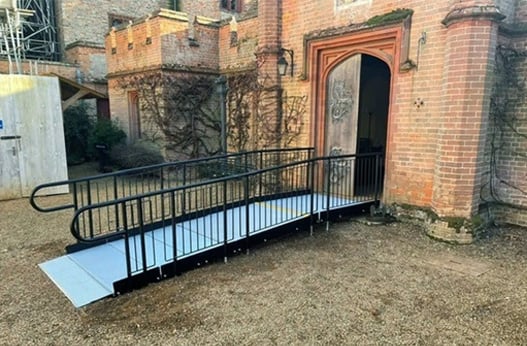
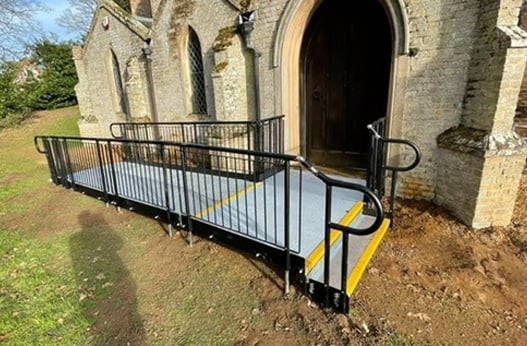
Ramps intended to provide access to historic or listed buildings may also require planning permission or listed building consent, particularly where drilling into walls or altering the structure is necessary. We typically aim to avoid making contact with historic building walls wherever possible, to minimise any damage.
For long-term permanent installations, it is the customer’s responsibility to confirm requirements with the local planning authority and Building Control at an early stage. Careful planning helps ensure ramps are safe, compliant, and installed with minimal impact.
Do you have a project in mind? Request a free estimate—we’re happy to chat about your needs and see how we can help.
Help with accomplishing building control sign-off for access requirements
Here are the stages to follow to ensure we can efficiently help you with your enquiry:
1. Share your requirements with Rapid Ramp by filling in our quick price form.
2. Rapid Ramp will run through your requirements, asking questions regarding individual usage, if compliant features are needed, if a specific width and gradient needs to be achieved etc.
3. We provide 2D and 3D designs with detailed written specifications. The specification notes each design feature with reference to the page and location to the Approved Documents of M and K of the Building Regulations.
4. Ensure that you have assigned a Building Control Officer BCO for the project. The term 'building control officer' generally (although not always) refers to an employee of the local authority, whereas 'approved inspector' is a private sector individual or organisation. Either is your point of contact for sign-off.
5. With our system, we can provide pre-construction details of the ramp or steps, which the BCO can comment on. Alterations can be made to drawings before installation. We recommend all communication between you and your BCO is written and filed for ease of reference. He will be able to approve the designs at this stage.
6. Ramps and steps ultimately provide access to the buildings, and receiving written approval from a BCO will save you a sufficient amount of site time.
7. The BCO will need to do a final project sign-off, including evaluating the access points.
Consequences of not having building control sign off
Here are the consequences of not obtaining building control sign-off before installation:
- Delay in Building Handover: The building cannot be handed over to your client for use, affecting everyone involved, including the end-user.
- Client Dissatisfaction: Your client may have expected you to arrange the sign-off before installation. Failure to do so could make them reconsider using your services in the future.
- Penalty Charges: Your client may incur penalty charges for overrunning the project timeline, which could reduce your project profits.
Estimates can be returned within 24hrs if there is clear information given, including project address, drawings, photos and contact details.
THE UK’S EXPERTS IN MODULAR RAMP SYSTEMS.
Rapid Ramp
Riverside Works, Church Ln, Etchingham, TN19 7AS
Hours:
8am - 5pm, Monday to Friday
Products
Services
Projects
Sector
Resources
Calculators


