


Published on Monday 25th November 2019
Providing step-free access is a key requirement under UK Building Regulations and the Equality Act 2010. When choosing between wooden ramps and metal ramps, timber often seems like a familiar starting point. However, exposure to UK weather quickly brings challenges—from rotting joists and slippery algae to ongoing maintenance. Prefabricated modular metal ramps offer a cleaner, faster alternative that delivers immediate compliance and long-term durability.
Providing step-free access is a key requirement under UK Building Regulations and the Equality Act 2010. When choosing between wooden ramps and metal ramps, timber often seems like a familiar starting point. However, exposure to UK weather quickly brings challenges—from rotting joists and slippery algae to ongoing maintenance. Prefabricated modular metal ramps offer a cleaner, faster alternative that delivers immediate compliance and long-term durability.
Core Comparison: Timber vs Prefabricated Modular Steel ramps
| Performance Metric | Wooden (Timber) Ramps | Modular Metal Ramps | Regulation & Standard Reference |
| Primary Use Case | Permanent (single-use build) | Both Short-Term Hire & Permanent Use | Approved Document M (Section 1) |
| Installation Speed | Slow (days or weeks of on-site carpenter labour) | Fast (typically 24 hr installation time) | Approved Document M & Part K |
| Weather & Rot Resistance | Poor (rots when moisture exceeds 20%; warps & cups) | Exceptional (galvanised steel immune to rot and rust) | BS 8300-1:2018 (Section 8.4) |
| Slip Resistance | Poor (accumulates slick algae, moss, and slippery slime) | High (slip-resistant grit-bonded GRP or draining steel mesh) | Approved Document M (Section 1.26f) & BS 8300-1:2018 (Annex F) |
| Fire Safety Rating | Combustible (accelerates flame spread) | Fire-Resistant (safe for emergency escape routes) | Approved Document B & Approved Document K |
| Building Code Compliance | High risk of non-compliance over time due to warping | Guaranteed Part M & Part K compliance out-of-the-box | Approved Document M (Vol 2) & Approved Document K |
| Reusability & Removal | None (requires demolition; creates landfill waste) | 100% Reusable, reconfigurable, and recyclable | BS 8300-1:2018 (Inclusive Design) |
For the best modular ramp solution for your project, request a quick price. We’ll help you compare the options and find the right solution to suit your site requirements.
REQUEST A QUICK PRICE
Short-Term Hire Versatility vs Long-Term Permanent Performance
Modular metal ramps offer complete flexibility across different project lifespans:
- Short-Term Rental Hire: For temporary facilities—such as site offices, temporary school classrooms, or short-term healthcare access—purchasing a permanent structure is rarely cost-effective. Modular metal ramps can be hired for the exact project duration, installed in a day, and unbolted cleanly upon completion without damaging the surrounding ground or entrance.
- Permanent Installations: For fixed entrances, hot-dipped galvanised steel provides decades of maintenance-free service without rusting, rotting, or degrading.


- Wooden Ramp Limitations: A wooden ramp cannot be hired or easily relocated. Once built on-site, removing a wooden ramp requires complete demolition, creating single-use landfill waste and unrecoverable labour costs.


On-Site Fabrication Time and Installation Speed
Project schedules demand fast turnaround times to minimise entrance disruption:
- Timber Construction Delays: Building a wooden ramp requires measuring, cutting, treating, and assembling timber on-site. If concrete pad footings are poured, curing takes 3 to 4 weeks before the ramp can support full load capacities.


- Rapid Modular Deployment: Modular metal ramps are pre-engineered off-site using 3D CAD modelling. Components arrive ready for assembly, enabling trained specialist teams to complete full installations typically within 24 hours without noise, sawdust, or curing delays.
Structural Durability, Moisture Thresholds, and Rot
UK weather subjects external access structures to constant moisture, freeze-thaw cycles, and heavy footfall:
- The 20% Moisture Decay Threshold: Structural timber begins to rot and attract wood-boring insect infestations (such as woodworm) whenever its internal moisture content exceeds 20%. Continuous UK rainfall quickly pushes outdoor wood past this threshold, causing wet rot, dry rot, and joist failure.
- Warping and Tripping Hazards: As timber absorbs water and dries out repeatedly, boards warp, bend, and split. This creates loose fixings, popping screws, and uneven slopes.
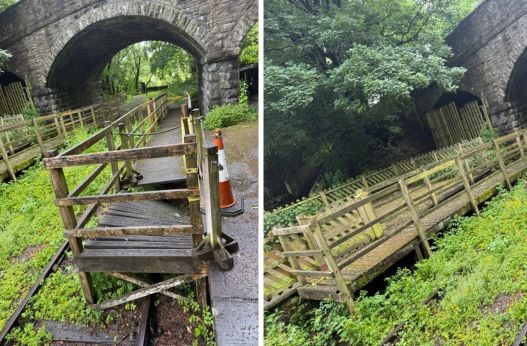
- Galvanised Steel Resilience: Modular metal ramps are non-porous and protected by hot-dip galvanising in zinc. They are unaffected by moisture, frost, or rot, retaining exact structural dimensions over decades.
All-Weather Traction and Slip Resistance
Slip resistance is essential for wheelchair users, crutch users, and pedestrians:
- Wooden Ramp Hazards: Shaded or wet timber platform boards rapidly grow a layer of algae and moss. Rain or frost transforms this layer into an extremely slippery surface where wheelchair tyres lose traction.
- Modular Metal Platform Options Explained:
- GRP (Glass Reinforced Plastic) Platform Surface: Features a tough, grit-bonded slip-resistant finish. This durable textured surface gives wheelchairs and pedestrians exceptional traction underfoot, even in heavy rain or icy conditions.
- Draining Open Steel Mesh: An open grid design that lets rainwater, snow, and slush pass straight through the walkway surface. Because water cannot pool on the ramp, ice patches cannot form in winter.
Fire Safety & Emergency Egress
External access routes frequently serve as primary or secondary emergency fire escape routes:
- Wooden Ramp Fire Risks: Wood is a combustible material. In a building fire, a wooden ramp can ignite, accelerating flame spread along the building envelope and blocking escape routes.
- Fire-Resistant Steel Ramps: Hot-dipped galvanised steel is inherently fire-resistant. Prefabricated metal ramps maintain structural integrity during fire emergencies, ensuring safe egress in full compliance with Approved Document B and Part K.
Total Cost of Ownership (TCO) Comparison between Timber Ramps Vs Metal Modular Ramps
While timber ramps may appear to have a lower upfront material price, its lifetime operational costs tell a very different story:
| Cost Element | Wooden (Timber) Ramps | Modular Metal Ramps | Relevant Regulation / Standard |
| Upfront Purchase & Setup | Low material cost; high carpenter labour hours | Moderate equipment cost; minimal 24 hr install time | Approved Document M (Vol 2) |
| Ongoing Maintenance & Cleaning | High (frequent pressure washing, sealants, & slip-resistant paint) | Zero (no painting, re-sealing, or chemical treatments) | BS 8300-1:2018 (Section 8.4) |
| Mid-Life Repairs | High (frequent replacement of warped or rotted timber boards) | Zero (steel is immune to warping and fungal decay) | Approved Document M (Section 1.26) |
| End-of-Life Removal | Demolition expense; sent to landfill as waste | Retains high resale value; 100% recyclable or returned from hire | EPD Verified / BS 8300-1:2018 |
| Overall TCO Verdict | High Cumulative Lifetime Cost | Lowest Overall Lifetime Cost | Equality Act 2010 & Part M |
Frequently Asked Questions (FAQs)
1. Are wooden wheelchair ramps safe for long-term outdoor use?
Outdoor wooden ramps present significant long-term safety risks. Wood absorbs rainwater and rots once internal moisture exceeds 20%, leading to structural weakening and splintering. Damp timber also rapidly grows algae and moss, creating a slippery surface. Furthermore, timber is combustible, making it unsuitable for emergency fire escape routes under Building Regulations Part B.
2. Can modular metal ramps be hired for short-term projects?
Yes. Unlike wooden ramps that must be destroyed upon removal, modular metal ramps consist of bolted, prefabricated steel components. Through the Rapid Ramp Hire Scheme, ramps can be quickly installed for temporary projects (such as site offices, temporary classrooms, or events) and unbolted cleanly when no longer needed.
Need a temporary access solution? Request a Quick Price and we’ll help you find the right modular ramp hire solution for your project.
3. Why do wooden ramps take longer to install than modular metal ramps?
Wooden ramps require manual measuring, cutting, fitting, and assembly on-site by skilled carpenters. If concrete footing pads are required, curing can take 3 to 4 weeks. Modular metal ramps arrive pre-engineered from 3D CAD designs and are installed by specialist teams within 24 to 48 hours.
4. Which ramp material lasts the longest outdoors?
Hot-dipped galvanised steel is the longest-lasting material for external access ramps. The protective zinc coating prevents rust and corrosion for decades without structural degradation. Outdoor timber ramps typically deteriorate within a few years due to water absorption, rot, and warping.
5. Do wooden ramps become slippery in wet weather?
Yes. Rainwater causes outdoor wood to absorb moisture and develop algae and moss, resulting in a low-friction, slippery surface. Modular metal ramps feature self-draining open steel mesh or grit-bonded Glass Reinforced Plastic (GRP) platform surfaces, allowing water to drain freely while delivering permanent high-traction slip resistance in accordance with BS 8300-1:2018.
6. Are wooden ramps compliant with UK Building Regulations?
Achieving and maintaining compliance with Approved Document M and Part K using timber is difficult over time. As wood absorbs water, boards warp and alter gradient ratios, handrails splinter, and surfaces become slippery, leading to potential Building Control failures. Modular metal ramps are engineered to satisfy these dimensions out-of-the-box.
Contact us for a orice for fully compliant modular ramp solution designed to meet the relevant requirements of Building Regulations Parts M and K.
7. What happens to a modular metal ramp when it is no longer needed?
Because Rapid Ramp's modular metal ramps are bolted together rather than permanently cast or nailed, they can be easily dismantled, reconfigured, or moved to another site. They carry high resale value, can be returned under hire agreements, or are 100% recyclable.
8. What is the best ramp material for public and commercial buildings?
Galvanised modular steel is the industry standard for public and commercial facilities. It fulfills all requirements under Approved Document M (Volume 2) and Part K, including fire resistance, 1500mm clear surface widths, warm-to-the-touch handrails, 100mm edge kerbs, and oftern a fast 24 hour installation.
CASE STUDIES


THE UK’S EXPERTS IN MODULAR RAMP SYSTEMS.
Rapid Ramp
Riverside Works, Church Ln, Etchingham, TN19 7AS
Hours:
8am - 5pm, Monday to Friday
Products
Services
Projects
Sector
Resources
Calculators


